Table of Content
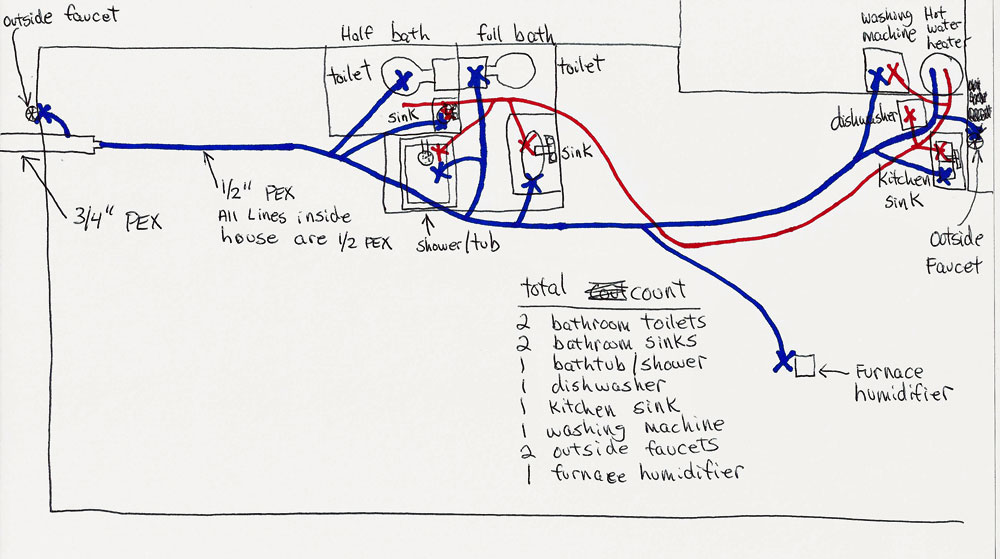
Trunk & branch and home-run piping systems are the two most popular ways to configure PEX tubing for domestic water. The traditional trunk & branch method includes main hot and cold lines that run through a building. Smaller lines branch off the main trunk with tees or small manifolds in order to feed water to fixtures. Home-run systems typically use single hot and cold manifolds mounted near a water heater, from which an individual line runs to each fixture. The intuitive piping setup makes home-run systems popular among do-it-yourselfers, and Viega’s Manabloc simplifies installation. When deciding between these two types of piping, note the advantages listed below and watch our plumbing manifold video for more information.

I would have it drained under the bench seat in shower . This would cut the runs to ~6'-15' compared to 50'. The 2nd WH would not use as much electricity b/c it is always fed by a hot line . I feel this is a better solution than a re-circ system b/c the master bath is the only place where hot water use is most important. A large-diameter (3/4 in.) main water line feeds the manifold; smaller lines run from the manifold to each fixture. Any fixture in the house can be shut off at the manifold.
Fittings
Although this is not as wastefull as a 3/4" trunk line it is more of a concern on wait time. There are many ways to design submanifold systems, which require far less pipe and drilling than a home-run system. Rather than one main manifold, each bathroom, laundry, and kitchen gets its own submanifold.
I would not want to have to wait for both the shower and the sink to have hot water arrive. "Certain fixtures, such as a large tub, will need 1/2" home run lines, but most fixtures don't. Toilets, sinks, showers, clothes washers, and standard-size tubs all perform very well on 3/8" lines." Certain fixtures, such as a large tub, will need 1/2" home run lines, but most fixtures don't. Toilets, sinks, showers, clothes washers, and standard-size tubs all perform very well on 3/8" lines.
Hybrid Systems
I'm not saying a traditional trunk system is the best either. I will go through many water heaters before the loop even begins to show age. I have a house that has a good size crawl space under the length of the house. I didn't read the article on the remote manifold system. Air and water have similar characteristics when it comes to movement. You can see the way that water reacts to obstacles as it flows across and around them, and how it behaves when a large flow is contained in a narrow opening, or when the tide changes and there is an opposing flow.
You can have endless hot water fairly rapidly and takes up half the space. Yes, it's more money than what you propose, but you needn't worry about a tank having a leak in your closet, nor ever running out of hot water for your tub or shower. I have a friend with a long ranch house, and there's a small BTU tankless at the kitchen end, and a larger BTU one at the bath end. Is there a reason to run an HR system for cold lines if there is no concern on waiting for hot water?
Why Logic Plumbing Beats Home Run and Trunk and Branch
It is very important to design, installation of plumbing before installation. In many plumbing systems, the fault occurs due to wrong installation or other problem. So the best option is to first customize the design and plans to facilitate all the staff. So that it is easy for the maintenance team to perform repairs in future.
Use a drop-ear bend support to hold the tubing in a tight bend . There are several types of shutoff valves that connect directly to PEX. Half-inch PEX tubing costs about one-third the price of copper.
Or any system that works with the F1960 standard where the fittings are the same internal diametre as the pipe. That only applies when all fixtures are running full out, a scenario that doesn’t happen very often. You can apply demand factors to reduce the size of large trunks. Don't bother with plumbing in the slab since you can run it in the attic. Good practice in slab would be to create abs conduits with no lips to be able to feed/pull the PEX.
Also, since PEX is more flexible and available in long lengths, it can work better for ‘fishing’ through walls in remodeling situations. Personally I would just live with the trunk and branch. It will be very expensive to replumb the house. I like the manifold arrangement but one quick thing to try would be to just plumb the washing machine into the end of the branch line. I this this would allow the other fixtures to have pressure preference over it. Please do check the pressures, though, if you are able.
This means that the 3/8 line will carry far more water than faucets can deliver in these days of water-conserving fixtures. Shower valves, for example, can deliver only 2-1/2 gal/min, and that's the combined flow of hot and cold. You may be able to outrun your 3/4" feed though. If you have 20+ outlets you probably have laundry, showers, and hose bibbs all sharing that 3/4" feed.

Issue for me is, I've got 1/2in copper already in the garage as the starting point. But I know I'll need to make the most of the pressure I get from it. PEX piping is the biggest revolution since the flush toilet. Learn what it is and everything in between with this PEX plumbing guide. I agree with you that PEX A and B are different the problem is when you get bids or talk to the plumbers some will gloss over the differences and just say PEX. I have attached a copy of the floor plan… the longest run will be about 40′ from utility room to master vanity.
Also, most fixtures won’t even flow the full amount of water a 1/2” pipe is capable of delivering, so there is often no need to oversize a supply line. If there is some fixture where the wait for hot water bothers you, consider adding a dedicated 3/8" or 1/2" line for it. Perhaps 10 seconds vs 1 minute (longer than you might calculate since 3/4" typically won't achieve "plug flow"). Except for radiant heating no water lines get run in the slab, they get run under it. It isn't a first choice, but rather something you sometimes have to do out of necessity. For pex under a slab I run it in 3" pvc conduit with sweeps. That way it can be replaced if necessary.

All those added connections greatly increase your liability with more potential for leaks, plus it also limits the performance of the system with increased pressure loss. A 1/2" line will easily handle two shower heads if you have 40 psi or more water pressure. A trunk-and-branch system made of PEX would be cheaper than a PEX HR system, but not much cheaper.